
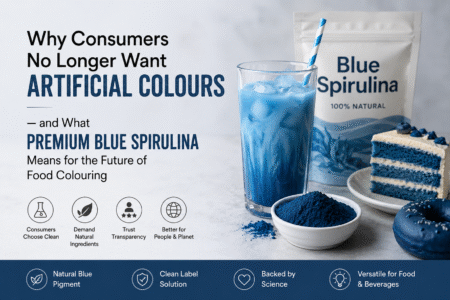
Walk through a supermarket today and you will notice a clear change in the way food and beverage products are being positioned. Consumers are paying closer attention to ingredient labels, looking for simpler formulations, and increasingly questioning the use of synthetic additives and artificial colours.
For food and beverage brands, this shift creates both a challenge and an opportunity.
Colour remains one of the most important sensory attributes of a product. It influences expectations, helps communicate flavour, and can make a product more visually appealing. But as consumers increasingly prefer products perceived as natural and minimally processed, brands are under pressure to rethink how they achieve vibrant colours.
Blue is particularly challenging.
Unlike yellow, orange, or red, there are relatively few naturally derived sources that can provide a bright, attractive blue suitable for modern food and beverage applications. This is where Premium Blue Spirulina (Phycocyanin) is gaining attention.
Derived from spirulina, phycocyanin is a naturally occurring blue pigment-protein complex that can provide vibrant blue colour for selected food, beverage, and formulation applications.
The Growing Consumer Shift Away From Artificial Colours
Consumer expectations around food ingredients have changed significantly.
People are not simply buying a product based on taste and price anymore. They are increasingly considering:
- What ingredients are used?
- Are the colours naturally derived?
- Is the ingredient recognizable?
- Does the product fit a clean-label positioning?
- How does the product align with sustainability and wellness expectations?
This does not mean every consumer completely rejects synthetic colours. Rather, it reflects a broader market movement toward transparency and naturally positioned ingredients.
For brands, this creates an important distinction: the colour itself is not enough anymore. Its source and formulation story also matter.
A bright blue product may attract attention on the shelf, but consumers increasingly want to understand what creates that colour.
Why Artificial Colours Are Facing Greater Scrutiny?
Artificial food colours have traditionally offered manufacturers several advantages. They can deliver strong colour intensity, consistent performance, relatively low cost, and stability across many applications.
However, they can also create challenges for brands targeting consumers who actively seek naturally positioned products.
Artificial Colours: A Growing Health Concern
That bright red, vivid yellow, or electric blue may make food look more appealing—but what is behind the colour?
Some synthetic food colours have come under increasing scientific and regulatory scrutiny because of potential health concerns. In one significant example, the FDA revoked authorization for FD&C Red No. 3 after studies found that high exposure caused cancer in male laboratory rats through a hormonal mechanism. While the FDA says this particular mechanism does not occur in humans, the finding has contributed to the wider debate around the continued use of synthetic food colours.
The concern goes beyond a single colour. In recent years, regulators and food manufacturers have increasingly examined the safety and long-term implications of petroleum-based synthetic dyes. The FDA has taken steps toward reducing their use and encouraging the development of naturally derived alternatives.
When Colour Becomes a Health Question?
Consumers are no longer looking at food colour purely from an aesthetic perspective. They are asking a much bigger question:
“Do we really need synthetic chemicals to make our food look attractive?”
Artificial colours may provide intense, consistent shades at a low cost, but they add visual appeal rather than nutritional value. As awareness of food ingredients grows, consumers are increasingly interested in products made with recognizable and naturally derived ingredients.
This shift is pushing food and beverage brands to rethink how they achieve colour—and whether synthetic dyes are still the best choice.
The Shift Away From Synthetic Dyes
The conversation is now moving from “How bright can we make the product?” to “How naturally can we colour it?”
This is where naturally derived colour ingredients are gaining attention. Ingredients such as phycocyanin from blue spirulina offer manufacturers an alternative way to create vibrant blue shades while supporting the growing consumer preference for naturally sourced ingredients.
For brands responding to the clean-label movement, replacing synthetic colours isn’t simply a formulation change. It is becoming part of a broader commitment to transparency, ingredient awareness, and the future of food manufacturing.
Why Blue Is One of the Hardest Colours to Replace?
Replacing artificial colours is not equally difficult across the colour spectrum.
Natural sources can provide many shades of yellow, orange, red, and green. Achieving a vivid, commercially useful blue is considerably more challenging.
This has made natural blue colourants particularly valuable.
Brands developing blue beverages, desserts, confectionery, functional foods, and supplements need an ingredient that can deliver an attractive colour while fitting the product’s broader formulation and positioning requirements.
Phycocyanin offers one of the most commercially interesting natural blue options.
What Is Premium Blue Spirulina (Phycocyanin)?
Premium Blue Spirulina refers to a purified blue pigment fraction obtained from spirulina biomass.
The key pigment is phycocyanin, a naturally occurring blue protein-pigment complex responsible for much of spirulina’s characteristic blue colour.
It is important to distinguish blue spirulina from conventional whole spirulina powder.
Whole Spirulina vs. Blue Spirulina
Whole spirulina powder contains a broader range of naturally occurring compounds, including chlorophyll, which gives it its familiar green appearance.
Blue spirulina, in the context of food colouring, generally refers to a phycocyanin-rich extract or pigment preparation in which the blue colour becomes the primary visual characteristic.
This difference makes phycocyanin particularly interesting for brands that want the visual impact of blue without introducing the strong green appearance associated with whole spirulina.
Why Brands Are Exploring Phycocyanin as a Natural Blue Colourant?
The appeal of Premium Blue Spirulina goes beyond simply replacing a synthetic colour.
Vibrant natural blue appearance
Phycocyanin can provide an attractive blue colour that can help brands create visually distinctive products.
In today’s highly visual food culture, colour can influence everything from shelf appeal to social-media photography.
Naturally derived positioning
For brands building products around naturally sourced ingredients, phycocyanin can support a formulation strategy that moves away from artificial colourants.
Strong visual differentiation
Blue remains an unusual colour in many food and beverage categories.
A naturally blue smoothie, functional drink, dessert, confectionery product, or nutritional formulation can immediately stand out from conventional products.
Versatile application potential
Depending on formulation, processing conditions, and regulatory requirements, phycocyanin can be explored across applications such as:
- Functional beverages
- Smoothies and drink mixes
- Sports nutrition products
- Confectionery
- Frozen desserts
- Ice cream
- Dairy and dairy-alternative products
- Nutritional powders
- Selected bakery applications
- Food supplements
- Modern food formulations
The exact suitability depends on the product matrix, processing conditions, target colour, dosage, and applicable regulations.
The Café and Beverage Opportunity
One of the most visible opportunities for natural blue colour is beverages.
Cafés, beverage brands, and foodservice businesses increasingly compete through visually distinctive products. A drink with a bright natural blue appearance can create a memorable customer experience and encourage social sharing.
This is particularly relevant for:
- Smoothies
- Wellness beverages
- Functional drinks
- Blue lattes
- Mocktails
- Shakes
- Frozen beverages
- Powder-based drink mixes
The opportunity is not simply to create a blue drink.
It is to create a visual product identity around naturally derived colour.
A brand can combine colour, flavour, ingredients, packaging, and storytelling to create a product that feels distinctly different from conventional artificially coloured beverages.
From Synthetic Blue to Natural Blue: What Brands Need to Consider
Switching from an artificial blue colour to phycocyanin is not necessarily a simple one-for-one substitution.
Manufacturers should evaluate several technical factors during product development.
1. Processing temperature
Phycocyanin is a protein-based pigment and can be sensitive to processing conditions.
High temperatures and extended heat exposure may affect colour performance. Manufacturers should therefore assess the pigment under the actual processing conditions used in their product.
2. pH
The formulation’s pH can significantly influence pigment behaviour and visual appearance.
Products with acidic profiles may require particular attention during development.
3. Light exposure
Natural pigments can respond differently to light compared with synthetic colourants.
Packaging and storage conditions should therefore be considered when developing a phycocyanin-coloured product.
4. Ingredient interactions
The presence of acids, minerals, proteins, preservatives, flavours, and other formulation components can influence colour performance.
Laboratory testing in the finished product is therefore more useful than relying only on performance data from a standalone ingredient.
5. Desired colour intensity
The required amount of phycocyanin depends on the target shade and product matrix.
A pale blue beverage and an intensely coloured confectionery product may require very different formulation approaches.
Natural Does Not Mean One-Size-Fits-All
One of the biggest mistakes brands can make is treating natural colourants as direct replacements for synthetic colours without considering formulation differences. Synthetic colours are often engineered for high stability and predictable performance. Natural pigments can behave differently.
Therefore, successful reformulation requires collaboration between the ingredient supplier, R&D team, food technologists, and quality teams.
A good development process should evaluate:
Ingredient → formulation → processing → packaging → storage → final appearance
rather than evaluating the colour ingredient in isolation.
Why Ingredient Quality Matters?
Not all phycocyanin ingredients are identical. Colour intensity, purity, processing method, stability, solubility, microbiological quality, and application performance can vary between products and suppliers.
For brands considering Premium Blue Spirulina, supplier evaluation should therefore go beyond price.
Important questions include:
- What is the pigment concentration?
- What purity specifications are available?
- Is the ingredient suitable for the intended application?
- What are the microbiological specifications?
- How is the ingredient processed?
- What documentation is available?
- What batch-to-batch consistency can be expected?
- What storage conditions are recommended?
- Can the supplier support application development?
- What regulatory documentation is available for the target market?
These questions become especially important for commercial products where colour consistency must be maintained across production batches.
Premium Blue Spirulina for Modern Food and Beverage Formulation
The movement away from artificial colours is not simply about removing an ingredient.
It represents a larger shift in product development.
Consumers increasingly want products that combine:
Visual appeal + recognizable ingredients + transparency + modern positioning
Premium Blue Spirulina (Phycocyanin) sits at the intersection of these trends.
Its vibrant blue colour can help brands create visually distinctive products while supporting a naturally derived colour story.
For food and beverage manufacturers, this creates opportunities to rethink how colour is used.
Instead of treating colour as a purely technical component, brands can make it part of the product experience.
Where Could Natural Blue Go Next?
The potential market for naturally coloured products extends well beyond smoothies and café drinks. As formulation technology improves, phycocyanin can become increasingly relevant to product developers exploring new concepts across:
Functional beverages:
Natural blue can help functional beverage brands create distinctive visual identities and premium product experiences.
Sports nutrition:
Protein drinks, recovery beverages, hydration products, and nutritional powders can use colour as part of a differentiated formulation strategy.
Frozen desserts:
Ice cream, sorbets, frozen yoghurt, and other desserts provide opportunities for visually striking blue products.
Confectionery:
Candy, gummies, and other confectionery products are highly visual categories where colour plays an important role in consumer appeal.
Nutritional products:
Powders and supplements can use natural colour to create distinctive formulations and improve visual differentiation.
Modern food concepts:
Innovative food brands are increasingly experimenting with unusual colours and ingredient combinations to create products designed for today’s visually driven consumer environment.
The Bigger Shift: From Artificial Ingredients to Ingredient Stories
Perhaps the most important change is not simply that consumers want “natural colours.” They increasingly want to understand why an ingredient is there and where it comes from.
This changes how brands communicate.
Instead of:
“Bright blue colour”
the product story can become:
“Vibrant blue colour from phycocyanin derived from spirulina.”
That difference may appear small, but it can fundamentally change how consumers perceive a product. Ingredient origin, sourcing, processing, and functionality are becoming part of the overall value proposition.
What Food Brands Should Do Now?
For brands considering a move away from artificial colours, the process should begin with product development rather than marketing.
A practical approach is:
- Identify products using artificial blue colours:
Determine which SKUs could benefit from reformulation.
- Define the desired colour:
Establish the target shade, intensity, opacity, and visual appearance.
- Evaluate the formulation:
Review pH, processing temperature, light exposure, and ingredient interactions.
- Test Premium Blue Spirulina:
Run laboratory and pilot-scale trials using the actual formulation.
- Evaluate stability:
Test the finished product through its intended shelf-life conditions.
- Review regulatory requirements:
Confirm that the ingredient and intended use comply with applicable regulations in each target market.
- Scale carefully:
Once the formulation performs consistently, move toward commercial production with appropriate quality controls.
The Future of Blue Food Colouring
The future of food colouring is unlikely to be defined by a single ingredient.
Instead, it will be shaped by a combination of consumer expectations, regulatory developments, formulation technology, ingredient innovation, and brand differentiation.
Natural colourants will continue to face technical challenges, particularly when manufacturers require the same stability and intensity traditionally associated with synthetic colours.
But the opportunity is significant. Premium Blue Spirulina (Phycocyanin) offers food and beverage innovators a way to explore vibrant blue colour while moving toward naturally derived colouring strategies.
For brands developing the next generation of beverages, desserts, confectionery, nutrition products, and modern formulations, natural blue is no longer just a visual trend.
It can be a powerful product-development opportunity.
Final Takeaway
Consumers are becoming more conscious of what goes into the products they buy, and artificial colours are increasingly being evaluated as part of that broader conversation.
For manufacturers, the challenge is to deliver the same visual excitement consumers expect while responding to demand for naturally positioned ingredients.
Premium Blue Spirulina (Phycocyanin) provides a compelling option for brands looking to explore vibrant natural blue colour in food, beverages, and modern formulations.
The next generation of colourful foods may not need to rely on artificial colours to stand out.
Natural blue could be the new way forward.
Algology — microalgae manufacturer & exporter in India
Explore our solutions: Spirulina Manufacturers in India · Blue Spirulina Manufacturers in India · Phycocyanin Manufacturers in India.