
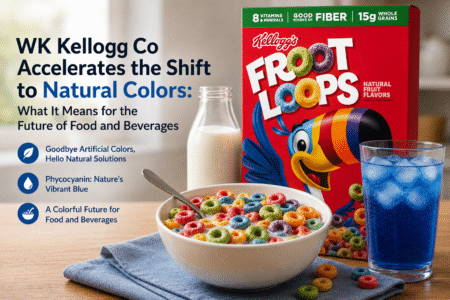
The food industry is steadily moving toward simpler, more recognizable ingredients, and WK Kellogg Co.’s latest announcement is another major signal of this shift.
On August 6, 2026, WK Kellogg Co. announced that it is accelerating its transition away from artificial colors across its cereal portfolio. The company says production of reformulated cereals, including popular products such as Kellogg’s Froot Loops and Apple Jacks, will begin later this year, with products expected to reach retailers before the end of 2026, one year ahead of its original timeline.
The change goes beyond removing artificial colors. WK Kellogg Co. is also moving ahead of schedule to eliminate BHT from the small amount of cereal packaging that currently uses the preservative.
For food manufacturers and ingredient suppliers, this development highlights a much broader trend: natural color solutions are becoming an increasingly important part of product reformulation.
A Major Step Away From Artificial Colors
Color plays an important role in food. It creates visual appeal, reinforces flavor expectations, and helps consumers recognize familiar products.
At the same time, consumers are increasingly interested in foods made with ingredients they consider simpler and more recognizable.
WK Kellogg Co. says it has identified natural solutions for the colors used across its colorful cereals, including red, orange, yellow, green, purple, and blue. The company plans to use
colors derived from natural sources such as fruit and vegetable juices and other plant-based ingredients. This is particularly significant for brightly colored products. Replacing artificial colors is not simply a matter of changing one ingredient on a label.
Manufacturers need to consider several factors, including:
● Color intensity and consistency
● Stability during processing
● Light and temperature exposure
● Interactions with other ingredients
● Shelf-life performance
● Consumer acceptance
Cost and supply availability WK Kellogg Co. says it conducted extensive consumer testing as part of the reformulation process, with the goal of maintaining the familiar appearance and taste of its cereals.
Why Natural Colors Are Gaining Momentum
The movement toward natural colors reflects a broader evolution in food formulation.
Today’s consumers increasingly examine ingredient lists and pay attention to how products are formulated. For brands, this creates an opportunity to rethink ingredients without necessarily changing the overall consumer experience.
Natural colorants can help manufacturers respond to this demand while maintaining the visual identity that consumers associate with their products. WK Kellogg Co.’s announcement is particularly notable because it involves a large, established cereal portfolio rather than a small niche product line. The company also says that approximately 85% of its cereal sales already contain no FD&C colors, demonstrating that the transition has been underway for some time.
The Importance of Natural Blue Colorants
Among the different food colors, blue can be one of the more challenging shades to formulate naturally.
Blue is widely used in cereals, confectionery, beverages, desserts, sports nutrition products, and other modern food applications. As manufacturers reduce their reliance on synthetic colors, demand for naturally sourced blue alternatives is creating new opportunities for ingredient innovation.
One of the most recognized natural blue ingredients is phycocyanin, commonly associated with blue spirulina.
Phycocyanin is a naturally occurring blue pigment-protein obtained from spirulina. It can provide a vibrant blue appearance and is increasingly being explored by food and beverage developers looking for alternatives to synthetic color systems.
This makes Phycocyanin / Blue Spirulina in Food and Beverage Applications particularly relevant to the broader natural-color movement.
Phycocyanin and the Future of Blue Food Applications
The potential of phycocyanin extends well beyond a single category.
Food and beverage manufacturers are exploring natural blue color solutions for applications such as:
● Functional beverages
● Sports and wellness drinks
● Smoothies and shakes
● Confectionery
● Frozen desserts
● Dairy and plant-based products
● Bakery applications
● Nutraceutical products
● Modern food formulations
For beverage manufacturers in particular, visual appearance can strongly influence consumer expectations.
A bright blue drink can communicate freshness, novelty, and modernity. However, achieving that appearance while maintaining a clean-label positioning or naturally colored product profile requires careful ingredient selection and formulation expertise.
That is where phycocyanin can become an important formulation tool.
Algology’s Algablu™: A Natural Blue Color Solution
As food manufacturers look for alternatives to synthetic blue colors, ingredient suppliers have an important role to play in providing reliable natural color systems.
Algology’s Algablu™ is positioned as a natural blue pigment solution derived from spirulina.
A vibrant natural blue colorant for food, beverages, and modern formulations, Algablu™ is designed for brands looking to explore naturally sourced blue coloring options across contemporary food and beverage applications.
The move toward natural colors by major food companies demonstrates why ingredients such as phycocyanin are becoming increasingly relevant to product developers.
For companies working on new beverages, colorful foods, or reformulated products, natural blue pigments can offer manufacturers a way to rethink color without abandoning the visual experience consumers expect.
Natural Colors Are About More Than Removing Synthetic Ingredients
It is important to understand that reformulation is not simply a substitution exercise.
When a manufacturer replaces an artificial color with a natural alternative, the formulation may need to be optimized from the ground up. Natural color performance can depend on several factors:
pH
Some natural pigments perform differently depending on the acidity of a formulation. Beverage developers therefore need to consider the final pH carefully.
Temperature Processing temperatures can influence pigment stability. Manufacturers need to understand how the color behaves during heating, pasteurization, or other processing conditions.
Light Exposure Packaging and storage conditions can affect the appearance of naturally colored products. Appropriate formulation and packaging strategies can therefore be important.
Ingredient Interactions Other ingredients in a formulation can influence color performance. Minerals, flavors, acids, and other components may interact with the pigment.
Processing Conditions Mixing, processing, and storage conditions all need to be considered when developing a stable natural-color system. For this reason, successful natural-color reformulation requires more than simply replacing an ingredient on the formulation sheet.
What WK Kellogg Co.’s Move Means for Food Manufacturers
WK Kellogg Co.’s accelerated transition provides an important lesson for food manufacturers: natural colors are moving from being a niche formulation option toward a mainstream product-development consideration.
The company’s announcement also follows other changes to its portfolio, including its commitment to simpler ingredients and the introduction of its SPOONS on-pack nutrition guide, which highlights attributes such as fiber, protein, and sugar levels.
This indicates that ingredient transparency and nutritional positioning are becoming increasingly connected with how major food brands communicate with consumers. For manufacturers, this creates several opportunities.
1. Reformulation Is Becoming a Competitive Advantage
Brands that successfully transition to naturally sourced colors can potentially differentiate their products in crowded categories.
2. Natural Blue Ingredients Will Become More Important
As artificial blue colors face increasing scrutiny from consumers and brands, interest in alternatives such as phycocyanin is likely to remain strong.
3. Beverage Innovation
Can Accelerate Beverages are particularly suited to visually distinctive colors. Natural blue pigments can support new concepts ranging from functional beverages to premium wellness drinks.
4. Ingredient Suppliers
Need Consistency As natural colors enter larger-scale commercial applications, manufacturers will need suppliers capable of providing consistent quality, specifications, and technical support.
From Cereal Aisles to Beverage Shelves
The significance of WK Kellogg Co.’s announcement extends beyond breakfast cereals.
When a major food manufacturer accelerates a large-scale transition to natural colors, it reinforces a direction that can influence multiple food categories.
Cereal manufacturers are not the only companies looking at natural color alternatives. Beverage, confectionery, dairy, sports nutrition, and functional food brands are also exploring ways to deliver attractive colors using naturally sourced ingredients. This creates an interesting opportunity for blue pigments. Blue remains one of the most visually distinctive colors available to food and beverage developers. As brands seek naturally sourced solutions, phycocyanin and blue spirulina can become increasingly relevant in food and beverage applications.
The Natural Color Revolution Is Gaining Momentum
WK Kellogg Co.’s decision to complete its artificial-color transition a year ahead of schedule is more than a company-specific milestone.
It reflects a broader transformation in how food manufacturers think about formulation, ingredient sourcing, and consumer expectations.
The company’s stated objective is to preserve the familiar taste and colors consumers know while obtaining those colors from natural sources.
That approach captures the central challenge facing today’s food industry:
Consumers want familiar products, but they increasingly expect the ingredients behind those products to evolve. For food and beverage developers, this means natural colors are no longer simply an alternative for niche products. They are becoming an important part of mainstream product innovation.
As demand for naturally sourced colors continues to grow, phycocyanin and blue spirulina can play an increasingly important role in creating vibrant blue foods and beverages.
With Algology’s Algablu™ offering a vibrant natural blue color for food, beverages, and modern formulations, brands have an opportunity to explore naturally sourced blue color solutions as the industry moves toward the next generation of food and beverage products.