
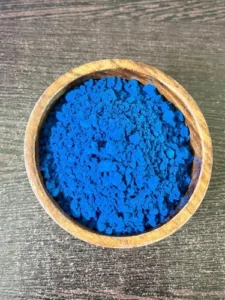
Blue spirulina has become one of the most eye-catching ingredients in health foods, smoothie bars and clean-label cosmetics. Yet many people are still unsure what it actually is, how it differs from ordinary spirulina, and whether that intense blue is natural. This guide answers all of it in plain language.
What is blue spirulina?
Blue spirulina is phycocyanin — a natural blue pigment extracted from spirulina, a nutrient-rich blue-green microalgae. Regular (green) spirulina is the whole dried algae, containing every part of the plant. Blue spirulina is different: it is the isolated blue protein-pigment, separated from the rest of the algae. That is why it has such a vivid colour, a far milder taste, and a higher price than green spirulina powder.
In short: all blue spirulina comes from spirulina, but not all spirulina is blue. The blue is one specific component — phycocyanin — concentrated and purified.
Where the blue colour comes from
Spirulina naturally contains several pigments: green chlorophyll, yellow carotenoids and blue phycocyanin. When manufacturers extract the phycocyanin and remove the green chlorophyll and other components, what remains is a brilliant blue powder or liquid. Phycocyanin is water-soluble, which is why blue spirulina dissolves so easily into drinks and turns them a striking blue.
Blue spirulina vs green spirulina
| Green spirulina | Blue spirulina | |
|---|---|---|
| What it is | Whole dried algae | Extracted phycocyanin pigment |
| Colour | Dark green | Vivid blue |
| Taste | Strong, earthy | Nearly neutral |
| Main use | Nutrition, protein | Natural colour + antioxidant |
| Price | Lower | Higher (it is a concentrate) |
Is blue spirulina good for you?
Phycocyanin, the compound that makes blue spirulina blue, is a water-soluble antioxidant studied for anti-inflammatory and free-radical-scavenging properties. While blue spirulina is used mostly for its colour, it also carries some of spirulina’s nutritional appeal. As a food ingredient it is generally considered safe for most people, though anyone pregnant, nursing, or managing a health condition should speak with a doctor before taking it as a supplement.
What is blue spirulina used for?
- Natural food colouring — smoothies, lattes, lemonades, ice cream, confectionery and baking, replacing synthetic blue dyes.
- Nutraceuticals — supplements that highlight phycocyanin’s antioxidant profile.
- Cosmetics — serums, masks and colour products that want a clean-label blue.
- Functional beverages — wellness drinks that use its colour as a visual signal of “natural”.
How is blue spirulina made?
Production begins with cultivating high-quality spirulina in clean, controlled conditions. After harvesting, the biomass goes through a gentle, water-based extraction that isolates the phycocyanin. The extract is then purified and carefully dried at low temperatures to protect the pigment, because phycocyanin degrades with heat and light. The final product is graded by purity — expressed as an “E ratio” — where higher grades are purer and more intensely coloured, and cost more.
How to choose quality blue spirulina
Look for a certified, batch-tested product with a consistent colour and a purity grade matched to your use (food colour, cosmetic, or high-purity). Cheap, uncertified material can be dull, inconsistent, or even contaminated with heavy metals, so certifications such as FSSAI, ISO and HACCP are worth checking.
Frequently asked questions
Is blue spirulina the same as spirulina? No. It is a pigment (phycocyanin) extracted from spirulina, not the whole algae.
Is the blue colour natural? Yes — phycocyanin is a naturally occurring pigment, not a synthetic dye.
Does blue spirulina taste like anything? Very little, which is why it colours food without changing the flavour.
Is blue spirulina more expensive than green? Yes, because it is a purified concentrate that needs much more raw material and processing.
Where can I buy quality blue spirulina? From a certified producer — Algology is a blue spirulina manufacturer in India supplying bulk and private-label phycocyanin worldwide.