Ancient
3.5B years ago algae oxygenated
Earth. Ancestors to every plant today.
Used in China (250 AD), by Aztecs
(Spirulina), and in traditional Asian
diets (seaweed).

Produces 50% of Earth's oxygen, captures CO2 efficiently, requires minimal land & water, and powers biofuels & bioplastics.
Sustainable aquaculture & livestock feed, reduces overfishing, cuts methane, and strengthens global food security.
Provides compounds for pharmaceuticals, vaccines, biomaterials, and even NASA space life-support systems.
Superfood rich in protein, vitamins, antioxidants, and omega-3 fatty acids - vegan-friendly and sustainable.
Algae lipids enable carbon-neutral biofuels, wastewater treatment, and circular economy integration.
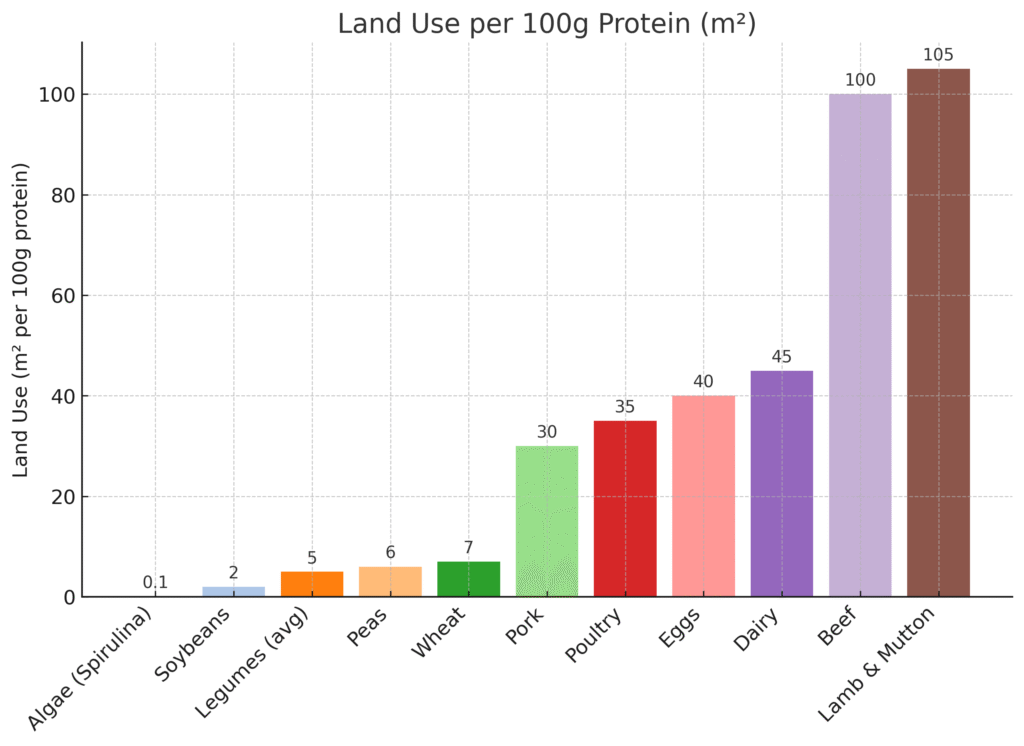
Source: Poore & Nemecek (2018), Science, via Our World in Data. Algae values estimated from spirulina/microalgae LCA studies.
3.5B years ago algae oxygenated
Earth. Ancestors to every plant today.
Used in China (250 AD), by Aztecs
(Spirulina), and in traditional Asian
diets (seaweed).
1600s microscopy discovery. 1800s
industrial Agar & Carrageenan. WWII:
critical in food, textiles, and medical
uses.
1950s-2000s: Spirulina & Chlorella for
nutrition, biofuel research, applications
in aquaculture, cosmetics,
nutraceuticals, and wastewater
treatment.
Superfoods, biofuels, carbon capture,
bioplastics, pharmaceutical drugs and
vaccines, and NASA space research.
Algae in space colonies, next-gen
fuels, biotech-driven pharmaceuticals
and nutrition, sustainable textiles, and
advanced climate solutions.
No. 15/11, First Floor, NSDR Nidhi Building, Rama Street, Nungambakkam, Chennai, Tamilnadu, India – 600034.
Algology. All Rights Reserved. Developed by Pixel Tech
