
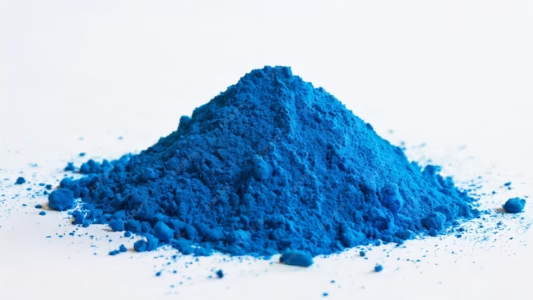
Blue spirulina — more accurately the water-soluble pigment phycocyanin extracted from Arthrospira (commonly called spirulina) — has become a high-value natural colorant and nutraceutical ingredient. Indian manufacturers who produce Blue Extract from Spirulina must follow strict quality standards across cultivation, extraction, purification, testing and packaging to deliver a safe, stable and consistent product for food, beverage, cosmetics and supplement customers.
What manufacturers mean by “Blue Extract from Spirulina”
“Blue Extract from Spirulina” usually refers to concentrated phycocyanin, the blue phycobiliprotein responsible for spirulina’s vivid color and many of its functional properties. Phycocyanin is valued both as a natural food colorant and for antioxidant / nutraceutical claims, so quality control is essential.
1. Responsible raw-material sourcing & cultivation controls
Top manufacturers control the entire upstream chain:
Strain selection — using well-characterized Arthrospira strains with high phycocyanin yield.
Water and nutrient monitoring — ensuring pond/tank water quality, conductivity, and nutrient profiles are within specification.
Contamination prevention — measures against cyanobacterial contaminants, heavy metals and pesticides (regular testing and closed-system photobioreactors where needed).
Traceability — batch IDs and harvest records so any downstream issue can be traced to source.
These controls lower the risk of foreign contaminants and variability in pigment yield.

2. Extraction & purification best practices
Manufacturers aiming for high-quality Blue Extract from Spirulina generally use gentle, food-safe extraction techniques to preserve pigment activity:
Aqueous extraction (water-based) to avoid solvent residues.
Clarification & centrifugation to remove solids.
Membrane processes (micro/ultrafiltration, diafiltration) to concentrate pigment and remove low-molecular impurities.
Ion-exchange or other chromatographic steps when higher purity is required (for pharma/analytical grade).
Combining aqueous extraction with membrane and chromatographic steps is a common industrial route for producing food-grade to reagent-grade phycocyanin.
3. Purity metrics manufacturers report
Quality is measured by analytical tests; one widely used purity indicator for phycocyanin is the absorbance ratio A₆₂₀/A₂₈₀ (phycocyanin peak vs. total protein at 280 nm). Industry benchmarks:
A₆₂₀/A₂₈₀ ≥ 0.7 — commonly accepted as food grade phycocyanin.
Ratios between ~0.7 and ~3.9 indicate higher (reagent) purities; analytical/pharmaceutical applications require still higher purity.
Reputable suppliers publish Certificate(s) of Analysis (CoA) with A₆₂₀/A₂₈₀, phycocyanin content, moisture, ash, and microbial/metal tests.
4. Safety testing & regulatory compliance
Leading Indian manufacturers follow national and international regulatory frameworks:
FSSAI requirements for food ingredients and nutraceuticals, including permitted limits and labelling rules. Spirulina-derived ingredients are recognized for use under these frameworks with usage guidance.
Routine testing for heavy metals (lead, arsenic, mercury, cadmium), microbial limits (total plate count, yeast & mold, pathogens), pesticide residues, and allergenic contaminants.
For exports, compliance with EU, US FDA (where applicable) and other buyer-specific specifications is common.
5. Stability, formulation & processing considerations
Phycocyanin is sensitive to heat, light, pH and oxidation. Manufacturers apply techniques to ensure the Blue Extract from Spirulina remains usable in real-world applications:
Microencapsulation / spray-drying (with carriers like maltodextrin) to enhance thermal and light stability and to produce a free-flowing powder.
Freeze-drying (lyophilization) when maximal activity and color retention are needed.
pH buffering, antioxidant addition or packaging with oxygen scavengers to prolong shelf life. Microencapsulation and spray drying have been shown to significantly improve phycocyanin stability in food systems.
6. Analytical QC & third-party verification
Top manufacturers don’t rely on a single test. Typical QC panel includes:
UV-Vis spectrophotometry (A₆₂₀/A₂₈₀), total phycocyanin concentration.
HPLC or mass spec checks for specific impurities when required.
Microbiology (pathogens, spoilage organisms).
Heavy metals by ICP-MS/ICP-OES.
Moisture, water activity and solubility tests.
Stability studies (accelerated and real-time) for shelf-life claims.
Independent third-party labs and export buyers often require an external CoA for every shipment.
7. Certifications & manufacturing hygiene
Reliable producers typically hold:
GMP (Good Manufacturing Practices) or GMP-like systems.
ISO 9001 for quality management (where applicable).
Organic certification (NPOP/FSSAI organic regulations) if marketing as organic.
Facility hygiene, trained personnel, and documented SOPs for cross-contamination control.
Conclusion — what to look for when buying
When sourcing Blue Extract from Spirulina, ask suppliers for:
A recent CoA (A₆₂₀/A₂₈₀, heavy metals, microbial).
Process details (extraction method, drying method, any additives).
Traceability records (batch/harvest details) and stability data.
Evidence of regulatory compliance (FSSAI/other) and third-party lab reports.
By prioritizing these standards — responsible cultivation, documented extraction and purification, rigorous testing and smart formulation — manufacturers in India can supply a safe, stable and high-performing Blue Extract from Spirulina suitable for modern food, beverage and personal-care applications.
