
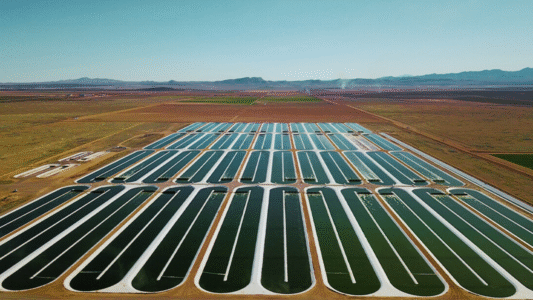
As industries face mounting climate pressure, resource constraints, and increasingly fragile supply chains, sustainability can no longer sit at the margins. It must be engineered into the system itself.
Microalgae offer one of the few biological platforms capable of doing exactly that.
Beyond food, nutrition, and functional ingredients, microalgae function as living infrastructure—capturing carbon, regenerating rapidly, and delivering multiple industrial outcomes from a single, resource-efficient system.
At Algology, microalgae are not treated as a commodity crop. They are cultivated as a biological system designed to support environmental resilience, industrial reliability, and long-term scalability.
Carbon capture built into the system
Microalgae absorb carbon dioxide as a fundamental part of growth, converting it into dense biomass through highly efficient photosynthesis. Unlike long-horizon or offset-based solutions, this process is: Continuous, with short and repeatable growth cycles Directly measurable, linked to biomass productivity Scalable across controlled and outdoor cultivation environments This positions microalgae as a practical tool for climate-aligned manufacturing—where carbon utilization is embedded into operations, not accounted for after the fact.
Resource efficiency beyond conventional agriculture
Traditional sources of protein and pigments place increasing strain on land, water, and climate stability. Microalgae operate on a fundamentally different model.
They:
- Require minimal land per unit of protein or pigment
- Use water efficiently through controlled reuse
- Grow independently of soil quality and seasonal constraints
This efficiency is what makes microalgae increasingly relevant across food systems, aquaculture, biotechnology, and emerging climate solutions.

From controlled growth to industrial output: the Algology process
For microalgae to function as infrastructure, cultivation must be engineered—not improvised.
Algology’s process is designed as a deliberate, scalable pathway that balances biological integrity with operational control.
It begins with pure seed stock cultivated under artificial light using CO₂ and organic nutrients. This laboratory phase establishes consistency and culture stability before scale is introduced.
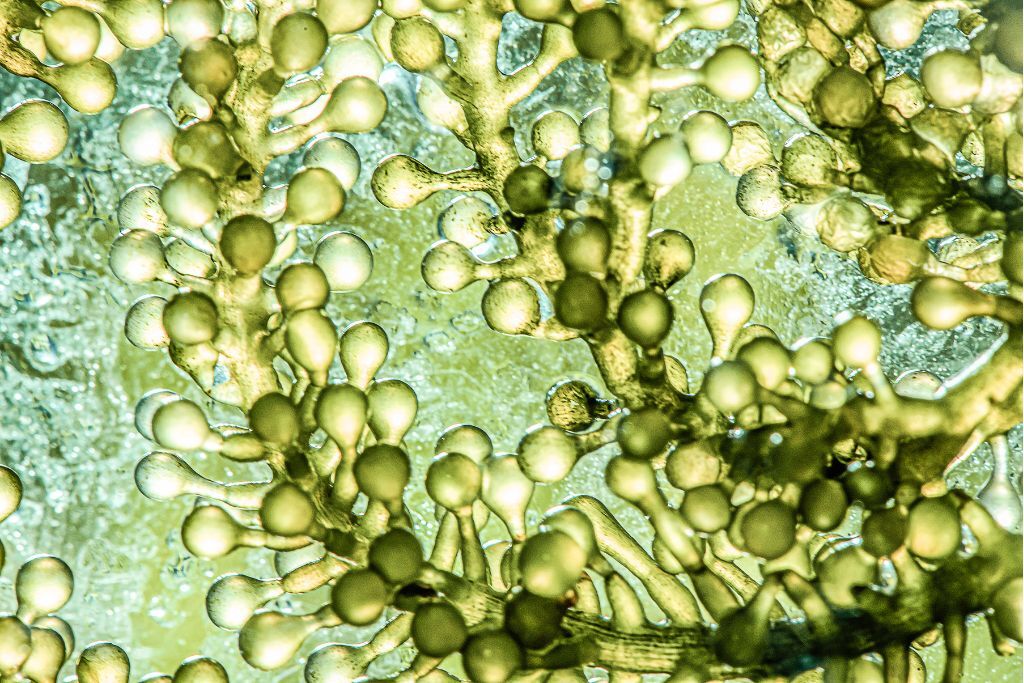
- Laboratory vessels, expanding from small flasks to larger volumes
- Intermediate basins, allowing gradual environmental adaptation
- Raceway ponds—first under shade nets, then in open sunlight—where natural photosynthesis drives large-scale growth
At every stage, light, nutrients, and carbon inputs are precisely managed to ensure predictable performance.
Once optimal growth is achieved, biomass is harvested and dewatered, efficiently separating solids from the growth medium. From here, the system divides into two defined product streams:
- One stream undergoes gentle extraction to produce vibrant blue Phycocyanin, followed by precise drying and secure packing
- The other stream is processed into nutrient-rich Spirulina, using controlled drying and packing to preserve quality
From laboratory control to sunlight-driven scale, from biomass to targeted outputs, every product reflects the same core principles: purity, potency, and consistency
One system, multiple outcomes
What sets microalgae apart is their stacked value potential. A single cultivation system can simultaneously deliver:
- Nutritional biomass for food and feed
- High-value functional compounds
- Carbon utilization and oxygen generation
- Circular nutrient and water flows
This is what elevates microalgae from an ingredient to infrastructure. Sustainability is not layered on—it is intrinsic to how the system operates.
Infrastructure thinking enables industry resilience
Reframing microalgae as climate infrastructure shifts the conversation from what they replace to what they enable.
They enable:
- Cleaner, more reliable natural colour systems
- Sustainable nutrition and protein pathways
- Reduced dependence on climate-vulnerable crops
- Scalable solutions aligned with environmental responsibility
This is why microalgae are becoming increasingly relevant across food, beverages, nutraceuticals, pharmaceuticals, agriculture, and advanced biotechnology.
Building the future, biologically
Microalgae have shaped the planet before—oxygenating the Earth billions of years ago and laying the foundation for life. Today, they offer something equally critical: a way to align industrial growth with planetary limits.
At Algology, cultivation is not just production. It is systems engineering through biology.
From tailored algae solutions and large-scale supply to research collaborations and application support, Algology partners with organizations ready to build sustainable innovation from the ground up.
Because microalgae are small by scale—but infrastructural by nature.
