
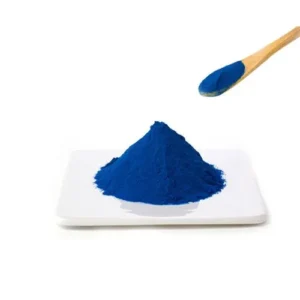
Spirulina — a nutrient-dense microalgae celebrated for its protein, vitamins, and vibrant blue pigment — has moved from niche health-food stores into mainstream food, cosmetics, and nutraceuticals. At the heart of this shift is phycocyanin, the natural compound responsible for spirulina’s brilliant color and commercial value when refined into Blue spirulina extract. Recent advances in AI and automation are changing how spirulina is grown, monitored, harvested, and extracted, improving yields, quality, and sustainability.
Precision cultivation: AI farms that think
Traditionally, spirulina cultivation relied on manual monitoring of ponds or photobioreactors for pH, temperature, light, and nutrient levels. AI changes this by using sensor networks and machine learning models to predict and optimize growth conditions in real time. Cameras, dissolved-oxygen probes, spectrometers, and pH/EC sensors feed continuous data into models that: Detect suboptimal conditions (e.g., temperature spikes or contamination) before they impact biomass. Recommend or automatically apply corrective actions — adjusting nutrient dosing, shade, aeration, or CO₂ levels. Forecast biomass growth and schedule harvest windows to capture peak phycocyanin concentrations for the highest-quality Blue Extract. This precision reduces human error, lowers energy and chemical use, and increases overall productivity.
Automated harvesting and logistics
Automation extends beyond sensors. Robotic harvesters and conveyor systems can remove biomass from open ponds or photobioreactors with minimal human intervention. Coupled with AI forecasting, these systems:
Harvest when biomass composition (not just volume) is optimal for extraction.
Minimize downtime and mechanical stress on cultures.
Route harvested material through an automated processing line to drying and extraction units, reducing contamination risk and preserving pigment integrity.
Automation of these front-end processes preserves the quality of raw material destined to become Blue spirulina extract, directly impacting yield and purity.
Smarter extraction: maximizing phycocyanin yield
The extraction of phycocyanin — the target compound for Blue spirulina extract — is a delicate process. Overheating, harsh solvents, or poor cell disruption can degrade the pigment and reduce purity. AI-driven process optimization tackles this in a few ways:
Adaptive extraction recipes: Machine learning models analyze incoming biomass properties (moisture, cell wall strength, previous growth conditions) and select the optimal combination of mechanical disruption, solvent or buffer concentration, temperature, and time.
Predictive maintenance: AI flags when extraction equipment (homogenizers, centrifuges, filters) will underperform, preventing quality drops due to mechanical faults.
Closed-loop control: Sensors in the extraction line measure pigment concentration and turbidity in near real time, allowing the system to tweak parameters mid-run to preserve phycocyanin integrity.
These innovations increase phycocyanin recovery while reducing waste and solvent use — improving both economics and environmental footprint.
Quality control at scale with computer vision and analytics
High-value Blue spirulina extract commands premium prices when purity and color metrics meet industry standards. Computer vision and spectroscopy integrated with AI permit non-destructive, in-line quality assessments that used to require lab time:
Vision systems inspect biomass and extracted liquid for particulate contamination, color consistency, and turbidity.
Spectrometers provide fast estimates of phycocyanin concentration and purity ratios.
Data analytics trace quality issues back to upstream events (e.g., an unnoticed pH drift in a specific pond), enabling targeted remediation and continuous improvement.
This enables manufacturers to guarantee consistent product quality and reduces costly batch rejections.
Sustainability and cost-efficiency gains
AI and automation also support sustainability goals. By optimizing nutrient dosing, reducing energy use for mixing and lighting, and minimizing solvent consumption during extraction, operations shrink their environmental footprint. Predictive algorithms reduce waste by aligning supply with demand — harvesting only what’s needed and timing production runs to lower energy prices or favorable grid conditions.
Economically, these efficiencies translate to lower unit costs and better margins for manufacturers of Blue spirulina extract, making natural phycocyanin more competitive against synthetic dyes and other colorants.
Challenges and paths forward
Despite clear benefits, adoption isn’t without hurdles:
Capital intensity: Sensors, robotics, and computing platforms require upfront investment.
Data quality: ML models need robust, clean datasets; many small producers lack the logging infrastructure to train accurate models.
Regulatory and validation needs: Food and cosmetic-grade extracts must meet stringent safety and purity standards — automated systems must be validated to satisfy regulators.
However, modular, cloud-assisted solutions, pay-as-you-go models, and shared data platforms are lowering barriers, enabling more farms and processors to adopt these technologies.
Conclusion
AI and automation are ushering in a new era for spirulina cultivation and phycocyanin extraction. From sensor-driven ponds to adaptive extraction lines and AI-enabled quality control, these technologies boost yields, improve the purity of Blue spirulina extract, reduce costs, and make the industry more sustainable. As platforms mature and costs fall, expect broader adoption that will expand the availability of natural blue pigments for food, cosmetics, and more — bringing the vivid hue of spirulina from the lab to mainstream products.
