
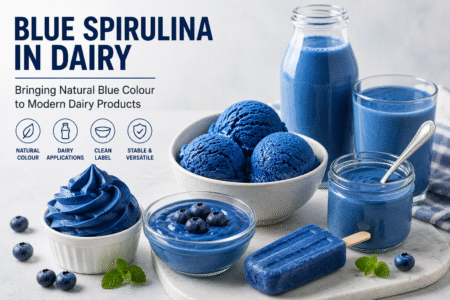
The dairy industry is entering a new era where consumers are looking beyond taste and texture, they also want recognizable ingredients, appealing natural colours, and products that align with modern clean-label expectations. This shift is creating new opportunities for natural colour ingredients, particularly Phycocyanin / Blue Spirulina in dairy applications.
Derived from Spirulina, Phycocyanin is a naturally blue protein pigment that can deliver distinctive blue shades in food and beverage formulations. For dairy manufacturers, Phycocyanin / Blue Spirulina offers exciting possibilities for creating visually striking products such as blue ice creams, frozen desserts, yogurts, milk-based beverages, and other innovative dairy concepts.
Research has also demonstrated the potential of food-grade C-phycocyanin in milk-based ice cream, with studies reporting limited colour loss over 182 days of storage. This highlights the growing potential of Phycocyanin / Blue Spirulina in dairy as manufacturers explore natural colour solutions that combine visual appeal with clean-label positioning.
What Is Phycocyanin / Blue Spirulina?
Phycocyanin is a blue pigment-protein obtained from Spirulina. Unlike whole spirulina, which has a predominantly green appearance because it contains chlorophyll and other pigments, purified phycocyanin provides a much cleaner blue colour.
This makes it particularly interesting for manufacturers that want to develop products with a vibrant blue appearance without relying on conventional synthetic blue dyes.
Algology’s Algablu™ is a natural blue pigment extracted from Spirulina through controlled cultivation and gentle extraction processes. It is designed for applications across food, beverages, desserts, dairy alternatives, and other formulations.
Why Is Natural Blue Colour Becoming Important in Dairy?
Colour plays an important role in how consumers perceive food. In dairy products, the traditional colour palette is dominated by white, cream, yellow, and fruit-derived shades. Introducing a natural blue colour can therefore create a strong visual point of difference. For brands, Phycocyanin can help support the development of:
● Premium and visually distinctive dairy products
● Naturally coloured ice creams
● Blue yogurts and fermented dairy concepts
● Functional milk-based beverages
● Frozen desserts
● Novelty dairy products
● Limited-edition and seasonal products
Phycocyanin in Ice Cream and Frozen Desserts
Ice cream is one of the most promising dairy applications for phycocyanin.
Unlike products that require prolonged high-temperature processing, frozen desserts can provide a more favourable environment for heat-sensitive natural pigments. Research on C-phycocyanin-added milk-based ice cream found that the blue colour remained relatively stable during 182 days of storage.
Another recent study developed naturally blue fermented ice creams using C-phycocyanin and observed colour stability over six months. The blue formulations also received strong consumer appreciation for appearance.
This creates opportunities for manufacturers to develop products such as:
Blue Spirulina Ice Cream | Blue Yogurt Ice Cream | Natural Blue Gelato | Blue Frozen Yogurt | Premium Blue Dairy Desserts
The colour itself can become part of the product experience and brand identity.
Phycocyanin in Yogurt
Yogurt is another interesting application, although formulation requires greater attention to pH.
Phycocyanin performs best within specific formulation conditions, and acidic environments can affect its colour stability. Dairy formulators therefore need to evaluate the pigment alongside the yogurt’s final pH, fermentation process, storage conditions, and other ingredients.
This does not mean phycocyanin cannot be used in yogurt. Instead, it highlights the importance of selecting an appropriate grade and designing the formulation around the pigment.
Potential applications include:
● Blue flavored yogurt
● Kids’ yogurt concepts
● Functional yogurt
● Premium Greek-style yogurt
● Frozen yogurt
● Dessert yogurt
● Seasonal and limited-edition yogurt products
Phycocyanin in Milk-Based Beverages
Milk-based beverages are another potential area for natural blue colour innovation.
Blue smoothies, protein beverages, flavored milk, dessert drinks, and specialty dairy beverages can use phycocyanin to create distinctive visual positioning.
However, beverage developers need to consider processing temperature, pH, light exposure, storage conditions, and interactions with other ingredients. Because phycocyanin is a protein-based pigment, excessive heat can reduce colour intensity.
For this reason, formulation and processing trials are essential before commercial-scale production.
What Makes Dairy a Good Application for Phycocyanin / Blue Spirulina?
Several characteristics make dairy and frozen dairy products interesting applications for phycocyanin.
1. Visually distinctive colour:
Natural blue remains relatively uncommon in mainstream dairy. A vibrant blue product can immediately stand out on a retail shelf.
2. Opportunity for clean-label positioning:
Brands looking to move away from synthetic colourants can explore natural colour solutions such as phycocyanin, depending on applicable regulations and the specific market.
3. Compatibility with premium products:
Blue can be associated with modern, premium, playful, and innovative food concepts. This makes it suitable for premium desserts and experiential dairy products.
4. Strong potential in frozen products:
Ice cream and frozen desserts avoid some of the high-temperature processing challenges associated with other food categories, making them particularly attractive for phycocyanin applications.
The Formulation Challenge: Heat and pH
While phycocyanin offers an attractive natural blue colour, it is not a simple drop-in replacement for every synthetic blue dye. The two major formulation considerations are temperature and pH.
Heat:
Phycocyanin is sensitive to high temperatures. Extended exposure to heat can affect its protein structure and reduce colour intensity. This is especially important for dairy products that undergo pasteurization, sterilization, or other thermal processing steps.
pH:
The pigment also responds to formulation pH. Research and reviews indicate that phycocyanin has better stability around mildly acidic to neutral conditions, while moving outside its preferred range can result in colour loss.
Therefore, successful dairy applications require more than simply adding a blue pigment. Manufacturers should test the complete formulation under actual processing and shelf-life conditions.
Choosing the Right Phycocyanin Grade
Different dairy applications may require different levels of colour intensity.
Algology’s Algablu™ is available in multiple colour-intensity grades, including E6, E18, E25, and E40, allowing manufacturers to select an appropriate grade according to their formulation and desired colour strength.
For example:
● E6: Light colour applications
● E18: Moderate colour intensity
● E25: High colour strength
● E40: Premium high-intensity applications
The ideal grade and dosage should always be established through formulation trials because the final colour depends on the dairy matrix, pH, processing conditions, dosage, and storage environment.
What Dairy Brands Should Consider Before Formulation?
Before introducing Phycocyanin / Blue Spirulina into a commercial dairy product, manufacturers should evaluate:
Product pH: Determine how the final pH affects colour stability.
Processing temperature: Minimize unnecessary thermal exposure where possible.
Dosage: Test different concentrations to achieve the required shade without over-colouring the product.
Light exposure: Evaluate colour retention under realistic packaging and storage conditions.
Shelf life: Conduct accelerated and real-time stability testing.
Ingredient interactions: Test the pigment alongside flavors, acids, sweeteners, stabilizers, proteins, and other formulation components.
Packaging: Consider packaging that helps protect sensitive natural pigments from environmental factors.
Regulatory compliance: Confirm that the selected colour ingredient and its intended use comply with the regulations of the target market.
The Future of Blue Dairy Products:
The rise of natural colours is encouraging dairy manufacturers to experiment beyond conventional product formats. Blue Spirulina provides an opportunity to combine natural colour innovation with familiar categories.
From bright blue ice creams to colourful yogurts and innovative milk-based beverages, phycocyanin can help brands create products that are visually distinctive while responding to consumer interest in naturally derived ingredients.
The opportunity is particularly strong in premium desserts, functional foods, children’s products, and social-media-driven food concepts where appearance can play an important role in purchase decisions.
Why Choose Algology for Phycocyanin?
Algology develops natural microalgae-based ingredients with a focus on quality, colour performance, and formulation versatility.
Its Algablu™ is a natural blue pigment derived from Spirulina and produced using controlled cultivation and gentle extraction methods. The product is available in different colour-intensity grades and can be supplied with technical documentation such as COA, MSDS, and technical specifications.
For dairy manufacturers, this provides an opportunity to explore natural blue colour solutions for ice creams, frozen desserts, dairy alternatives, beverages, and other innovative food applications.
Final Thoughts:
Phycocyanin / Blue Spirulina in dairy is more than a colour trend, it represents an opportunity for product innovation.
As dairy brands look for ways to differentiate products and explore naturally derived colour solutions, phycocyanin offers a compelling option for creating vibrant blue ice creams, yogurts, beverages, and frozen desserts.
The key to successful application is formulation expertise. By carefully managing pH, processing temperature, dosage, storage, and packaging, manufacturers can unlock the potential of natural blue colour while developing products designed for modern consumers.
With Algology’s Algablu™, dairy and food manufacturers can explore natural blue colour solutions backed by multiple colour-intensity grades and formulation support.
Frequently Asked Questions
1. Can Phycocyanin be used in dairy products?
Yes. Food-grade phycocyanin has been studied in dairy applications, particularly milk-based ice creams and fermented dairy products.
2. Can Blue Spirulina be used in ice cream?
Yes. Ice cream is one of the promising applications because frozen storage can support colour retention. Studies have demonstrated stable blue colour in phycocyanin-containing ice cream during extended storage.
3. Is phycocyanin suitable for yogurt?
It can be used, but yogurt formulations require careful evaluation of pH and processing conditions because these factors influence phycocyanin colour stability.
4. Is Blue Spirulina the same as regular Spirulina?
No. Blue Spirulina generally refers to the phycocyanin-rich extract obtained from Spirulina, while whole Spirulina contains additional pigments and nutrients and has a green appearance.
5. Is phycocyanin heat stable?
Phycocyanin is relatively heat-sensitive, so high-temperature processing can reduce colour intensity. Dairy manufacturers should evaluate the pigment under their specific processing conditions.
6. What is Algablu™?
Algablu™ is Algology’s natural blue pigment extracted from Spirulina and offered in multiple colour-intensity grades for food, beverage, dairy alternatives, desserts, and other applications.
Algology — microalgae manufacturer & exporter in India
Explore our solutions: Spirulina Manufacturers in India · Blue Spirulina Manufacturers in India · Phycocyanin Manufacturers in India.