
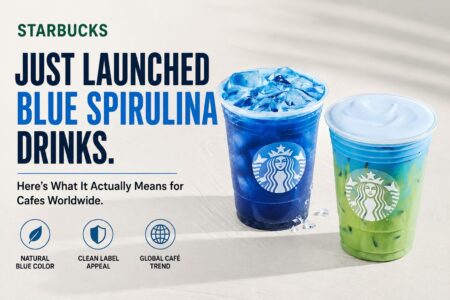
When Starbucks puts an ingredient on 40,000 store menus, it stops being a trend and starts being a specification.
In June 2026, Starbucks introduced a “Blue Coconut” beverage lineup in US stores — including an Iced Blue Coconut Matcha and a Blue Coconut Refresher — using blue spirulina to deliver the drinks’ vivid color, tied to a charitable partnership supporting clean water access. Food and beverage press covering the launch confirmed the color comes specifically from phycocyanin, the natural blue pigment extracted from spirulina, rather than a synthetic dye, and noted Starbucks has used blue spirulina in limited-edition drinks before this launch as well.
For independent and regional cafes, this is worth reading carefully — because what Starbucks does with an ingredient rarely stays a Starbucks-only story for long.
Why This Launch
Matters More Than It Looks
It’s proof of scale-readiness. A company operating tens of thousands of stores does not add an ingredient to its supply chain casually. Getting phycocyanin to perform consistently across that many locations — different water, different equipment, different staff skill levels — requires a stable, well-characterized ingredient. Starbucks choosing it signals that blue spirulina has crossed the threshold from “interesting for a boutique cafe” to “reliable enough for mass foodservice.”
It’s arriving inside a bigger regulatory shift. This launch isn’t happening in a vacuum. US regulators have moved to eliminate six petroleum-based synthetic dyes — including Brilliant Blue FCF (FD&C Blue No. 1), the dominant synthetic blue in food — from the food supply by the end of 2026. A major chain publicly adopting a natural blue alternative right as synthetic blue dye faces phase-out pressure is not a coincidence worth ignoring; it’s a preview of where every food brand’s blue colorant sourcing is headed.
It follows the exact pattern that made matcha universal. Matcha’s jump from specialty cafe ingredient to permanent mainstream menu item was accelerated dramatically once quick-service and major chains adopted it at scale — matcha menu presence has grown roughly 30% year-over-year recently, and market researchers specifically cite large-chain adoption (Starbucks among them) as a structural driver of matcha’s mainstream growth, not just a coincidence riding alongside it. Blue spirulina is now tracing the identical adoption curve, several steps behind matcha but on the same path.
What This
Means for Independent and Regional Cafes
You have a window, not a threat. A large chain adopting an ingredient doesn’t eliminate the opportunity for smaller cafes — it validates the ingredient and builds consumer familiarity you don’t have to create yourself. Customers who try a Starbucks blue coconut drink and like it will actively look for a “better,” more crafted version elsewhere. That’s your opening, not your competition.
Differentiate on craft, not novelty. Once a large chain has introduced an ingredient to the mass market, “we also have a blue drink” stops being a differentiator on its own. What still differentiates: visible technique (layering, ombré pours), ingredient transparency (naming your supplier’s purity or sourcing story), and flavor sophistication beyond a single formulation.
Expect supply tightening, not loosening. When a major chain adopts an ingredient at scale, it pulls meaningfully on the same global supply of raw material that independent cafes and smaller brands also depend on — matcha has already gone through exactly this, with several cafe operators reporting supplier switches and steep price increases as chain-level demand tightened supply. Cafes sourcing phycocyanin should treat supplier reliability and locked-in volume commitments as seriously as they treat recipe development.
Use this to educate your counter staff now. Customers are going to start asking “is this the same as what’s at Starbucks?” Give your team a clear, confident, accurate answer: phycocyanin is a natural extract from spirulina algae, used across many brands (including yours) for its color and clean-label profile — not something exclusive to any one chain.
What This
Means for the Broader Ingredient Market
A major chain’s adoption of phycocyanin over a legacy synthetic dye is a strong forward signal for:
- Formulators and food brands currently using
Brilliant Blue FCF or other synthetic blues, who now face both
regulatory pressure and consumer-facing precedent to reformulate. - Suppliers and manufacturers of phycocyanin, who
should expect rising demand and should be investing now in the
consistency, documentation, and scale that mass-market buyers
require. - Retailers and private label brands, who will
increasingly see “colored with blue spirulina” as a
shelf-differentiating claim worth pursuing ahead of competitors.
The Bottom Line
Starbucks didn’t invent blue spirulina’s popularity — cafes, wellness brands, and formulators were already moving toward it. What Starbucks did was confirm, at the largest possible scale, that phycocyanin is ready for prime time as both a functional and commercially viable natural blue colorant. For cafes and brands still sourcing synthetic dyes, the practical question is no longer “should we consider a natural blue alternative” — it’s “how quickly can we get a reliable, well-documented supply of one in place before the rest of the market catches up.”
FAQ
Did Starbucks really use blue spirulina in a real product launch? Yes. In June 2026, Starbucks launched a “Blue Coconut” beverage duo in US stores, including an Iced Blue Coconut Matcha and Blue Coconut Refresher, using blue spirulina for color as part of a limited-run charitable partnership. Starbucks has also used blue spirulina in earlier limited-edition drinks.
Is blue spirulina the same ingredient used in cafes generally, or something Starbucks made proprietary? It’s the same ingredient category — phycocyanin extracted from spirulina algae — used broadly across the food and beverage industry. It is not exclusive or proprietary to any single brand.
Does this mean independent cafes should stop offering blue spirulina drinks? The opposite. Mainstream adoption tends to build consumer awareness and demand that smaller, more craft-focused cafes can then capture, provided they differentiate on quality, technique, and ingredient transparency rather than competing purely on novelty.
Why is a large brand choosing a natural dye over synthetic ones right now? It lines up with active regulatory pressure in the US to phase out petroleum-based synthetic food dyes, including the dominant synthetic blue, Brilliant Blue FCF, by the end of 2026 — creating direct commercial incentive to adopt natural alternatives ahead of that deadline.
Algology manufactures phycocyanin (AlgaBlu™) engineered for consistency and scale across foodservice and manufacturing applications. [Talk to us about securing reliable supply →]