
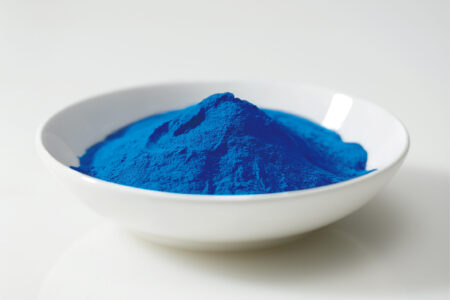
Natural blue is a holy grail for food formulators — clean-label, eye-catching, and derived from microalgae rather than synthetic dyes. The most promising candidate is phycocyanin, the brilliant blue pigment-protein from spirulina. But while phycocyanin looks great in a jar, bringing that vivid blue into heat-processed foods (think baked goods, canned soups, retorted sauces) is a substantial technical challenge. This post breaks down the main hurdles and gives practical, science-based fixes you can use in product development.
Why phycocyanin is tricky in heat-processed products
Phycocyanin is a protein complex that carries the blue chromophore (phycocyanobilin). Its appealing color comes with several vulnerabilities: Heat sensitivity. The protein structure unfolds with heat, releasing the chromophore and causing loss or shift of color. Typical high-temperature unit operations—baking, sterilization, retorting—are particularly damaging. pH dependence. Phycocyanin’s color and stability change with pH. Acidic environments commonly used in food preservation can accelerate pigment loss or lead to color shifts. Oxidation and light instability. Exposure to oxygen and light can bleach the pigment over time. Interactions with food matrices. Metal ions, reducing sugars, and other ingredients (e.g., dairy proteins, polyphenols) can bind or chemically alter the pigment. Solubility and rheology constraints. As a water-soluble protein, phycocyanin doesn’t always behave the same way in high-fat or high-sugar systems. Regulatory, cost and purity issues. High-purity phycocyanin is more stable but also more expensive; crude extracts are cheaper but contain impurities that reduce stability.
Practical fixes: formulation and process strategies
1. Reconsider where you add the color
The simplest, often most effective tactic is to add phycocyanin after any harsh thermal step. Examples:
Add to fillings, glazes, dressings, or frostings once cooled.
For canned or retorted products, consider coloring the top layer or adding an inner pouch/capsule that’s blended post-processing at reconstitution.
2. Replace or reduce high-temperature steps
Where possible, use non-thermal or milder preservation technologies that are gentler on pigments:
High Pressure Processing (HPP) preserves color and nutrients in many formulations because it avoids high temperatures.
Cold-fill / pasteurize-then-cool workflows let you apply milder heat and then add phycocyanin later.
These require capital and process redesign, but they substantially reduce pigment loss.
3. Stabilize the pigment physically: encapsulation
Microencapsulation — using carbohydrates, proteins, or lipid-based carriers — protects phycocyanin from heat, oxygen and light:
Spray-drying with maltodextrin or gum arabic can improve heat resistance for some applications (not suitable for very high heat).
Lipid or polymer-based microcapsules (e.g., complex coacervates, liposomes) provide stronger thermal shielding and controlled release.
Encapsulation also helps compatibility with fat-containing matrices and masks off-aromas.
4. Co-formulation with protective ingredients
Certain formulation choices slow degradation:
Antioxidants (natural tocopherols, ascorbic acid) limit oxidative bleaching.
Sugars and polyols and some hydrocolloids can stabilize proteins by preferential hydration and glass transition effects.
Chelators (e.g., citrates) help remove trace metal ions that catalyze pigment breakdown.
Carefully test for sensory impacts and regulatory limits when adding these ingredients.
5. pH engineering and buffering
If your product allows, adjust pH into the phycocyanin’s more stable range, or include buffers that resist acidification over shelf life. For acidic products, pairing phycocyanin with stabilizers (encapsulation, antioxidants) is essential because pH changes are often unavoidable.
6. Optimize packaging and storage
Oxygen and light accelerate loss. Use:
Oxygen-scavenging films, low-oxygen headspace and barrier packaging.
Opaque or UV-blocking materials.
Cold-chain or cool-temperature shelf recommendations to slow chemical reactions.
7. Source and purity selection
Higher-purity phycocyanin generally performs better because there are fewer impurities that catalyze degradation. Work with suppliers to:
Get certificates of analysis for pigment purity and metal content.
Trial different grades — sometimes a mid-grade with targeted stabilizers is the best cost-performance tradeoff.
8. Process tweaks and analytical control
Minimize hold times at elevated temperatures even if the peak temperature is required.
Use real-time color and protein assays during development to map degradation kinetics.
Run accelerated shelf-life studies that simulate your thermal process plus storage conditions.

Formulation workflow: a pragmatic checklist
Define the final processing (temps, times, pH).
Decide whether phycocyanin can be added post-process; if not, choose protective strategies (encapsulation + antioxidants).
Screen phycocyanin sources for purity and metal content.
Prototype with small batches using alternative processing (HPP or milder thermal profile) if feasible.
Validate color stability under expected storage (light, oxygen, temperature).
Iterate on packaging to limit oxygen/light exposure.

Bottom line
Phycocyanin gives a beautiful, consumer-friendly blue — but it’s a delicate biomolecule. There’s no single silver-bullet; successful use in heat-processed foods typically combines smart sourcing, protective formulation (encapsulation + antioxidants + buffers), process redesign (add post-heat or use HPP), and tight packaging control. With a systematic approach and targeted trials, you can bring natural blue into many applications that once seemed out of reach.
If you want, I can prepare a quick experimental plan for a specific product (e.g., a shelf-stable tomato soup or a baked cookie) showing sample process steps, candidate stabilizers, and key tests. Which product are you thinking of?
Algology — microalgae manufacturer & exporter in India
Explore our solutions: Spirulina Manufacturers in India · Blue Spirulina Manufacturers in India · Phycocyanin Manufacturers in India.