Power for a Better Planet

Rethinking Resource Efficiency

As global demand for food, materials, and energy grows, conventional systems are placing increasing strain on land, water, and ecosystems. Microalgae offer a fundamentally more efficient alternative: converting sunlight, carbon dioxide, and nutrients into valuable compounds in a sustainable way.

A Versatile Biological Platform

To use the cards that are already there with the updated wording
Human Health & Nutrition

Protein, omega-3s, vitamins, and antioxidants for sustainable nutrition

Animal Health & Food Systems

Sustainable feed for pets, livestock and aquaculture

Biotech & Healthcare

Bioactive compounds for pharmaceuticals and biomaterials

Energy & Environmental Systems

Biofuels, carbon capture, and circular production systems

Cosmetics & Materials

Natural pigments and functional ingredients

Why it matters

Microalgae combine multiple advantages in a single system:

  • High productivity with minimal land use
  • Lower water requirements than traditional agriculture, with capability for repurposing seawater
  • Ability to capture carbon dioxide while producing valuable outputs
  • Potential for circular, low-impact production systems

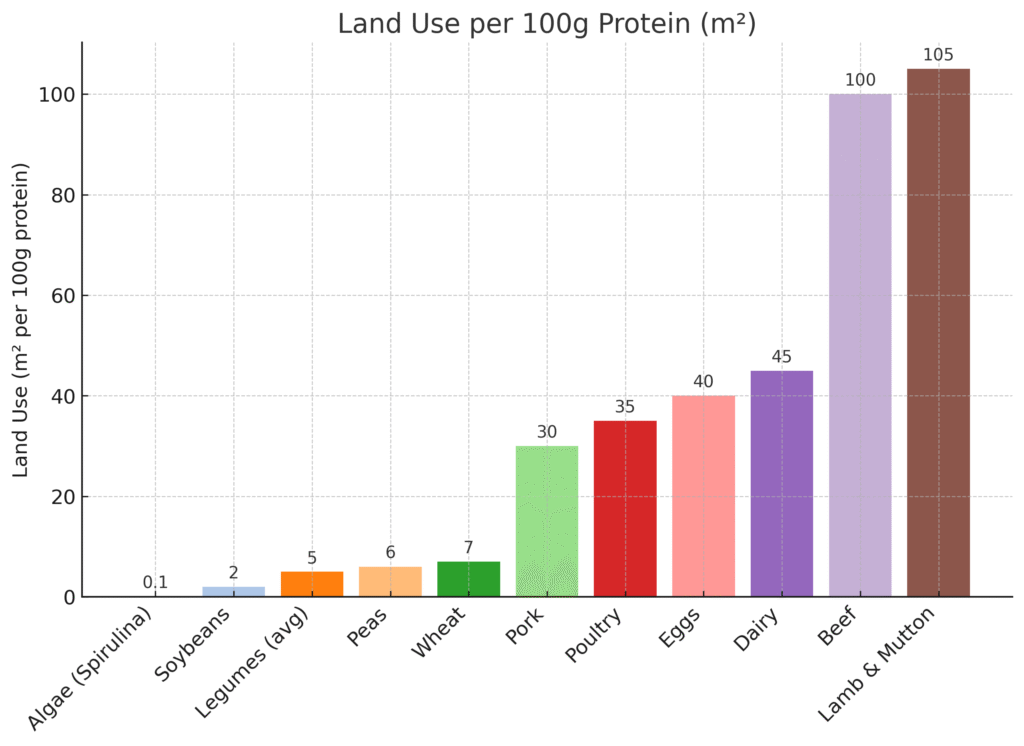
Microalgae require significantly less land than traditional protein sources

To use the existing land use chart and below source as is.

Source: Poore & Nemecek (2018), Science, via Our World in Data. Algae values estimated from spirulina/microalgae LCA studies.

From Ancient Origins to Future Systems

To keep the same format with the updated wording below:
Ancient

Oxygenated early Earth and laid the foundation for life, ~3.5 billion years ago

Industrial Era

Enabled extraction of compounds like agar and carrageenan in the 1800s

Modern Expansion

Adopted across nutrition, aquaculture, and biotechnology in the late 1900s

21st Century

Advancing into biofuels, carbon capture, and biomaterials

Future Outlook

Driving next-generation systems across food, energy, and beyond

A Platform for the Future
Algae have the potential to support sustainable food systems, enable new materials, and reduce environmental impact. Realizing that potential requires science, engineering, and scalable systems, to transform what algae can do into what they can deliver.
Need Help?